
The Alpine Mindset
A Toolkit for Survival and Success

From the unforgiving perspective of the alpine, there are three types of people - Senders, Planners, and Bitches.
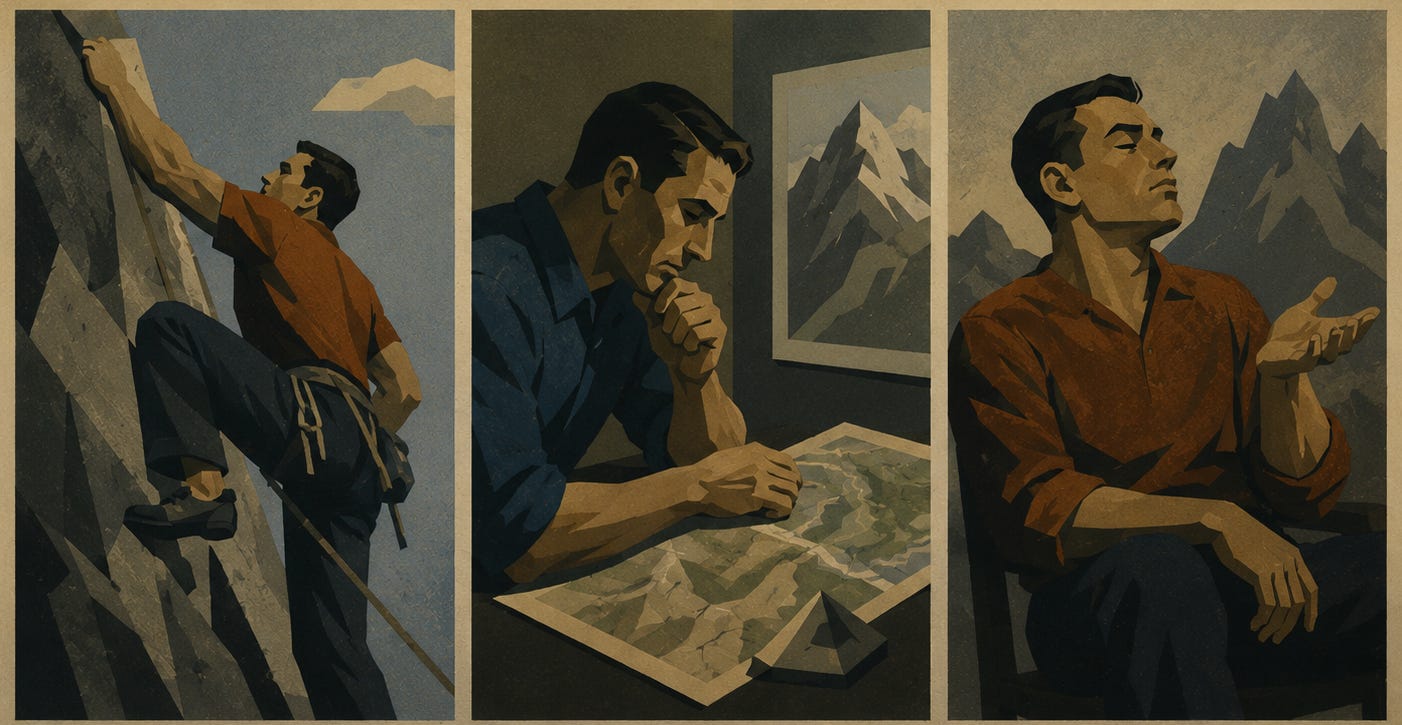
Senders are the people who show up and simply crush. They rock into the objective’s parking lot late, unkempt, and likely hungover from partying late the night before and yet somehow not only match the performance level of their team, but often exceed it. They operate by vibes and passion, drawing from a seemingly boundless well of energy to lock in and get things done when they need doing. It’s rare to see a Sender consulting a guidebook, and many posit that that’s more because they’re illiterate than because they’re incurious. Either way, there’s little point in discussing them further — whether through choice or lack of ability, Senders do not read.
Bitches are the people who stay home, or, in the rare case that they do make it to a trailhead, turn back far before the true alpine asserts itself and the car is more than a reasonable backtrack to retreat to. There’s also little point in discussing them, as they definitionally do not do anything interesting.
The final group is Planners. These are the alpinists pouring over guidebooks, trail reports, and best practices, and it is from them that we can learn a great deal. Planners use a combination of forethought and discipline to bridge the energy gap that Senders find themselves naturally across, and those same tactics are deeply valuable even in places that aren’t inches away from killing you at all times.
Success in the alpine as a Planner requires the deliberate cultivation of a mindset that is flexible, dispassionate, and above all else, effective. There is an entire vocabulary that has developed to describe the common mistakes alpinists make when attempting their objectives — “Summit Fever”, the mental state that overcomes even the most seasoned practitioners when getting close to their goal that causes them to push beyond the limits of safety, often with fatal consequences; “Expert Halo”, the propensity for group members to defer to the most experienced member of the team without double checking their work, positioning one person as a singular failure point; “Rack Fever”, the belief that simply having the right gear is a substitute for conditioning and proper preparation. The list extends endlessly, each term a small reminder that maintaining a proper mindset is just as important as gear, cardio, and team selection.
The Alpine Mindset is an incredibly useful tool that should be developed and applied by anyone looking to more effectively marshal their resources, even in environments far from the treeline. There are many useful adages and framing techniques that alpinists use to keep themselves safe and effective far from civilization, but most can prove helpful in our modern concrete jungles:
Slow is Smooth, Smooth is Fast
Whenever a video of mountaineers moving in dangerous situations breaks containment and spreads to scrollers unfamiliar with much beyond their civilized downtowns, a common comment is something along the lines of “someone’s life is on the line and you’re moving that slowly?”
Unsurprisingly, alpinists have very good reasons for moving seemingly slowly, and these reasons are well encapsulated by the common refrain “slow is smooth, smooth is fast”. Performing an action critical to a rescue operation once spends valuable seconds, but needing to redo it because of sloppy movements and mistakes could mean the difference between success and failure. Rushing to assist a partner but then, for example, blowing a crampon and losing footing, doubling the number of required rescues, helps no one and adds to an already fraught situation.
This is why alpinists tend to move with great economy of motion - they are trying to take every action once and only once. Deliberate movement, when contrasted with the frenetic Indian street vendor, seems lackadaisical, but watch a few street vendor videos and note how little movement actually moves towards the end product. Instead, huge amounts of effort are spent creating the image of speedy work, while the underlying task moves along slowly.
We must reject this impulse. Prioritizing flashy wins that “galvanize the troops” temporarily but without the underlying substance behind them not only wastes energy that could have gone to quieter but more durable progress, but also trains the average participant to expect and even prefer the flash over the substance. Online slapfights also fall into this wasteful category, with roughly nobody changing their underlying position based on them and the victors usually decided by little more than a popularity contest. They offer the shape of work without the sacrifices and patience required for progress forward in the social and physical realms.
Determine what the core few actions that most efficiently move the ball down the field, and do those first. We will find that time is rarely left over for anything else.
Active Control
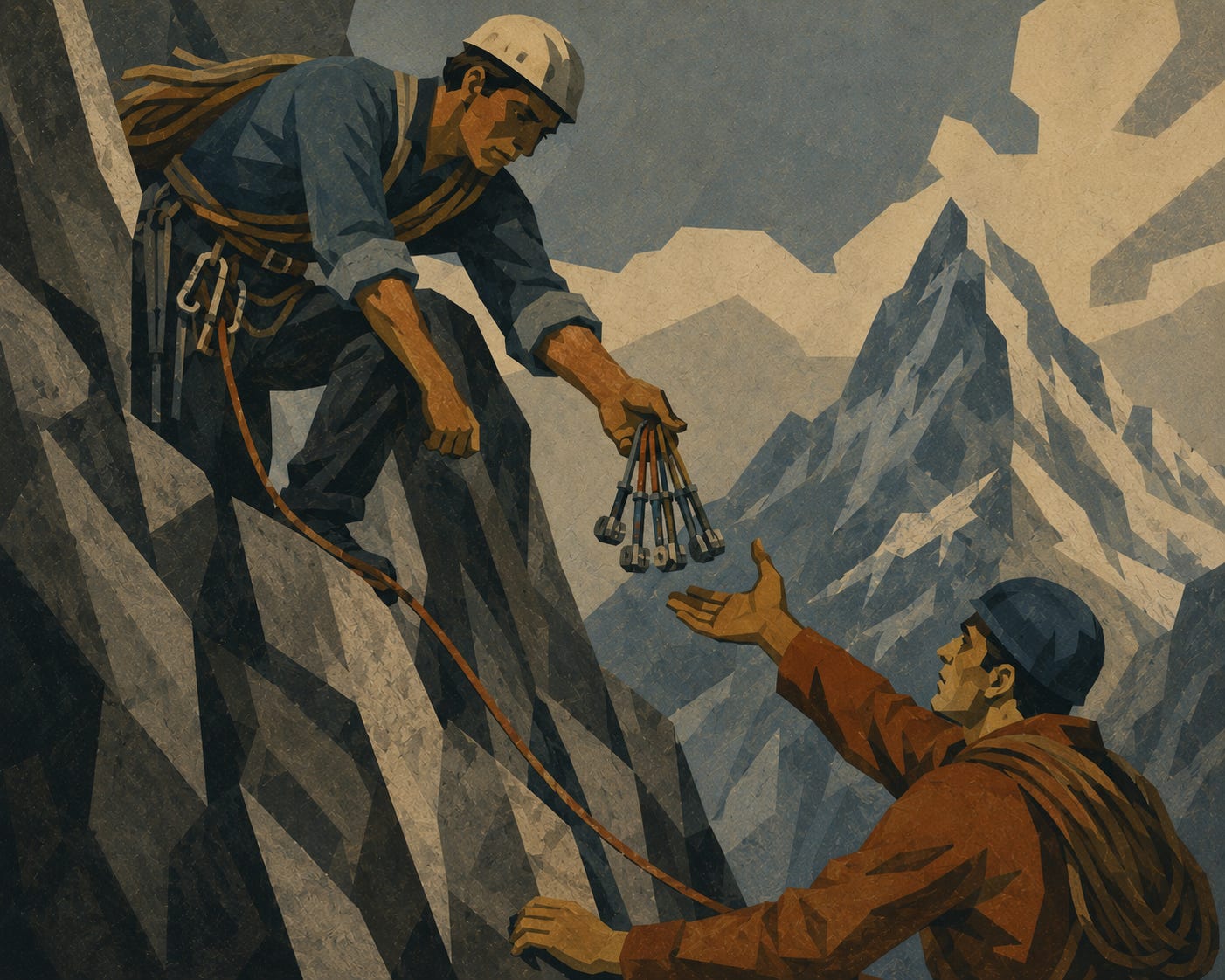
There is perhaps no worse feeling than being hundreds or thousands of feet off the ground, attempting to transfer necessary gear between partners, fumbling that handoff, and watching a key tool fall and bounce towards the ground like a baby peeking over their high chair, surprised to learn that gravity still works.
This most often happens during roped free climbs, where there is a large amount of gear such as cams, nuts, and sometimes even belay devices that need to be transferred between the partner who will be belaying the next pitch and so staying behind at the current anchor and the leader who will need the gear to protect their progress upwards.
Even without specific training, once a budding alpinist makes the mistake of dropping gear a few times, the delayed and after-dark returns to their car quickly teach them to mitigate it even if the $50-$200 costs to replace the pieces lost don’t. For guides and others that are more intentional with their training, however, the strategy settled upon by all is termed active control.
Core to the concept of active control is the commitment that no piece of gear’s ownership is ever in doubt. All gear and materials are under the active management of one alpinist at all times, and only during very specific circumstances are things put down and released from hands without being tethered to harnesses or packs. When transferring items, active control mandates that the receiving partner pull the item away from the giver rather than risk the fumbling ‘I thought you had it’ struggles that result in lost equipment and increased danger.
For political and cultural efforts, while there is a small amount of gear, there is an infinitely larger amount of power and responsibility. Those, also, cannot simply be shuffled easily from one party to another with the hopes that people will simply ‘get it’. Instead, roles and tasks should be intentionally pulled by the member stepping up, otherwise we will inevitably suffer the same blossoming separation of de facto and du jure that plagues modern bureaucracies.
Redundancy
Programmers strive for six nines in their uptime statistics, meaning about 99.999999% uptime — 31.5 seconds of downtime every year. Alpinists could be argued to strive for about the same in their safety statistics, and it’s worth noting that both recognize the impossibility of achieving both something meaningful and 100% safety.
This is most obvious in the approach to redundancy, where additional backup systems are created with the costs of maintaining them in mind and the aim is to maximize safety while still remaining nimble enough to reach the goal. New climbers often obsess about redundant carabiners, spare cams and other protection devices, and end up lugging an extra ten to twenty pounds to the base of their attempts without realizing that in most cases, they are trusting their life fully to one rope, one climbing partner, one belay device, and one person’s (their own) ability to stay on the wall.
When constructing organizations, some amount of redundancy is ideal. If the current chair or president is unfortunately hit by a bus, how many of the organization’s projects will continue on in their absence? Certain more difficult or high risk environments may require paying the costs of additional redundancy when the probability of failure rises to unacceptable levels - many European alpinists end up using double or twin ropes for a variety of reasons, but one of them is certainly redundancy. The proper goal, though, is not that all elements of a structure are non-critical and can fail without issue. Instead, we should focus on maximizing the elements that are fungible while also minimizing maintenance costs and keeping systems simple.
Don’t Learn Live
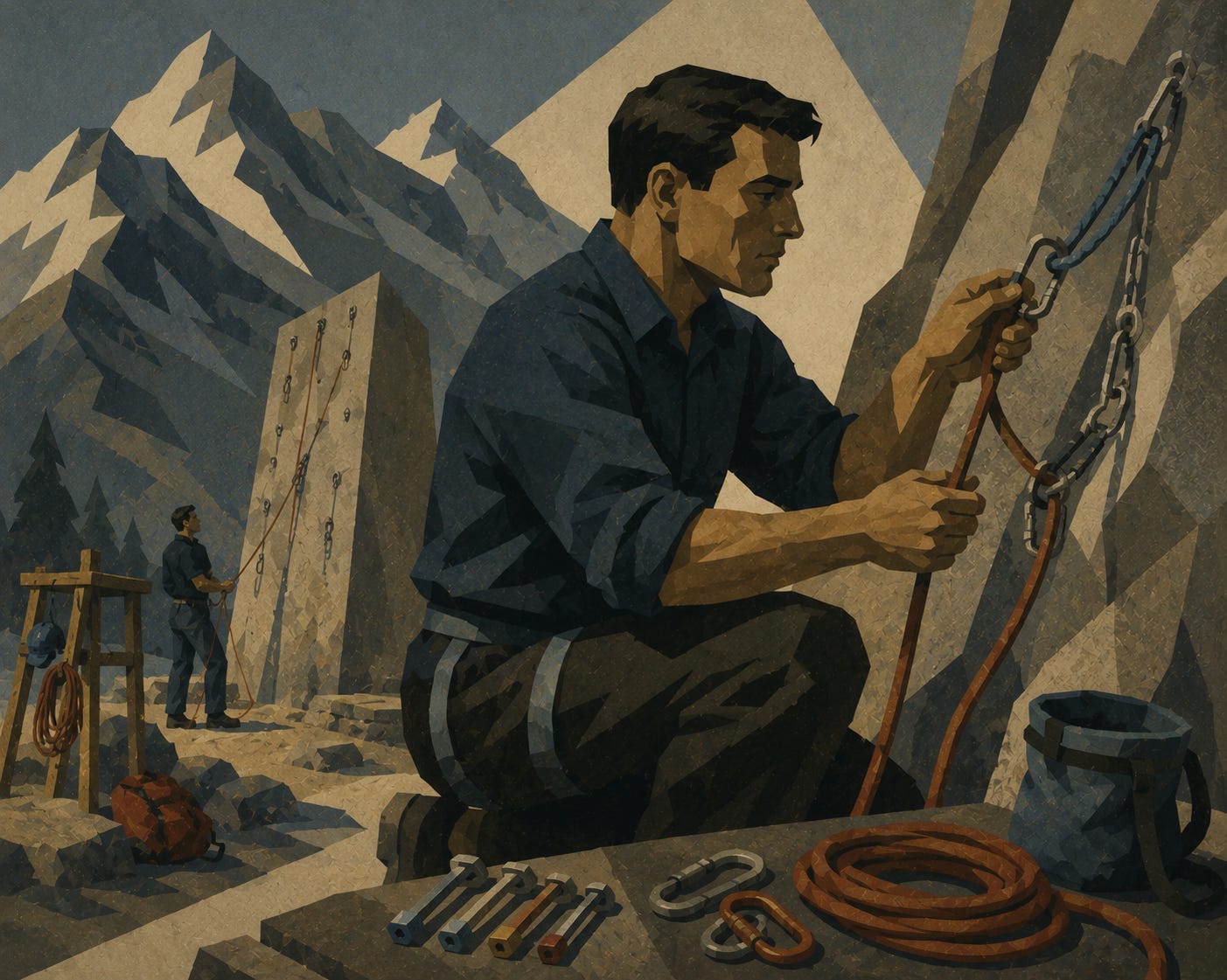
Many newly minted climbers or technical alpinists find themselves overcome by the excitement of a new and somewhat dangerous hobby, often diving headfirst into all that the sports have to offer and ending up in a remote area with minimal preparation, far outside their knowledge level.
The most obvious example of this is setting up rappels — sometimes, a new climber signs up for a large multipitch route (a route longer than one length of rope, requiring mid-route belays) and top out, worn out but satisfied. Then, after looking around and enjoying the view, they realize that they don’t have a sufficient familiarity with setting up a rappel to get down safely. If they’re lucky, they have a partner experienced enough to double check their work, but if they don’t, injuries and worse can easily happen.
There is no replacement for ‘live fire’, and any worthy objective will have some elements that are understood to be unique and difficult or impossible to simulate in a controlled training environment. But those elements must be minimized precisely because they resist simulation; controlling all variables possible in advance minimizes the damage uncontrollables and unknowns may have.
This is one of the best arguments for engaging with the modern democratic process, as futile as it may feel and as degraded as it has become. The leylines of power as they currently exist run through parliamentary procedure, bureaucratic organizations, and slow, plodding fundraising efforts. There is some value in remaining above the fray and separate from it, but there is a massive difference between being unwilling to waste time in a fundamentally failing structure and being unable to build or maintain a theoretically sound one.
As a result, modern men should find and shoulder responsibility as much as they can, wherever they may find it. If the structure they are doing so within is doomed, they should move on, but the skills gained in managing conflicts, convincing subordinates of your vision, and maintaining patience as progress takes far longer than it seems like it should will prove invaluable. These skills, especially the dogged patience that is required for so much of the coming work, are all but impossible to develop without grinding through the actual process. There is no fast lane, unfortunately.
Keep Systems Simple
Often redundancy is the typical way to overcomplicate a system, but there are many other ways to add complexity, and thus friction, to the basic ‘kit’ an alpinist builds when venturing into the mountains. Perhaps the newbie likes a particular overly convoluted belay technique because they saw it used in a cool Tiktok. Maybe they decide that more is always and obviously better, so they add pieces and knots in places that hurt more than help.
This is never clearer than when swinging leads on a multipitch route. On a long day, one above 10 pitches, even when ‘linking’ pitches by combining them (often, a pitch is defined by roughly half the length of rope, as that’s the maximum length of a standard double strand rappel), means about five swings of lead between partners. That means five transfers of gear, five awkward shuffles on narrow ledges, and five adjustments to anchor systems that might be trapping critical gear if not properly constructed.
This is where the budding alpinist learns to keep things simple, sometimes by sacrificing arguably required levels of redundancy. Every decision to trim perceived fat is made in furtherance of minimizing steps, reducing drag, and smoothing out the process to reach the objective.
Cribbing this impulse, we should seek to build systems that are as simple as possible, but no simpler. Every element should be scrutinized — can nomenclature be simplified? Can branding (both internal, for morale, and external, for marketing) be made more coherent and clear? Can Standard Operating Procedures be built, followed, and tuned to ensure that everything works like clockwork?
We are lucky that our every minute is not spent navigating acute life and death decisions, but we may be navigating that boundary for our culture and that task deserves to be treated seriously. By stealing the best techniques from those heavily incentivized to hone them well, we can learn the lessons they did without paying the costs they had to. Unfortunately, though, nothing will fully replace the mountains as the only place to truly learn the Alpine Mindset.